by Emmitt Barry, Worthy News Washington D.C. Bureau Chief
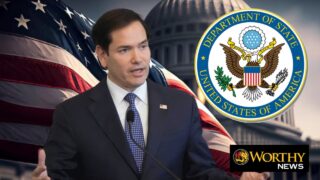
(Worthy News) – U.S. Secretary of State Marco Rubio delivered a blunt message to Iran on Monday: the United States will not accept any arrangement in which Tehran acts as gatekeeper to the Strait of Hormuz — demanding coordination, permission, or payment from vessels wishing to pass through what are, by international law, open waters.
Speaking on Fox News, Rubio laid bare the true nature of Iran’s so-called “offer” to reopen the strait: “What they mean by opening the straits is, yes, the straits are open — as long as you coordinate with Iran, get our permission, or we’ll blow you up, and you pay us.”
“That’s not opening the straits,” Rubio stated plainly. “Those are international waterways. They cannot normalize, nor can we tolerate them trying to normalize, a system in which the Iranians decide who gets to use them.”
This firm stance came after Axios reported that Iran had floated a deal to reopen the strait and end the ongoing conflict — while conveniently pushing nuclear negotiations to a later, undefined stage. The White House confirmed a discussion was underway but made clear it was far from acceptance.
White House Press Secretary Karoline Leavitt told reporters Monday that President Trump had reviewed the Iranian proposal with his national security team — but made no concessions. “I wouldn’t say they were considering it,” Leavitt said. “I would say there’s a discussion.”
Iran Stalls, Postures, and Plays Games
Iran’s Foreign Minister Abbas Araghchi signaled that Tehran was in no rush to negotiate. Araghchi traveled to Russia on Monday, meeting with President Vladimir Putin in Saint Petersburg, where he claimed that Iran had “become clear” as a “stable, solid, and powerful system” — despite ongoing U.S. and Israeli military pressure since late February. Putin, for his part, pledged continued strategic partnership with Tehran.
Meanwhile, Iran’s parliament is reportedly advancing legislation that would formalize military control over the strait — and require oil revenues passing through it to be collected in the Iranian rial. Less than 10 vessels crossed the strait on Sunday, a fraction of the 140 that passed daily before hostilities began.
Economic Pain Spreads Globally
Oil prices climbed back above $100 a barrel Monday, reflecting market anxiety over the continued disruption. European governments are feeling the strain — British Prime Minister Keir Starmer announced an emergency economic committee meeting for Tuesday with Bank of England representatives to assess the ongoing damage.
Germany’s Merz said the conflict was costing European taxpayers dearly and compared the U.S. engagement to past wars in Iraq and Afghanistan. He disclosed that European nations had offered minesweepers to help clear the partially mined strait — though no timeline for deployment has been set.
President Trump has sharply criticized NATO allies for not contributing naval assets to help restore commerce through the strategic waterway.
Copyright 1999-2026 Worthy News. This article was originally published on Worthy News and was reproduced with permission.
The following code is how the above article is generated with the Worthy Suite WordPress Plugin.
[worthy_plugins_news_story_body]This is how you display a story with an image.
Rubio Rejects Iran’s Extortion Scheme Over Strait of Hormuz
by Emmitt Barry, Worthy News Washington D.C. Bureau Chief
(Worthy News) – U.S. Secretary of State Marco Rubio delivered a blunt message to Iran on Monday: the United States will not accept any arrangement in which Tehran acts as gatekeeper to the Strait of Hormuz — demanding coordination, permission, or payment from vessels wishing to pass through what are, by international law, open waters.
Speaking on Fox News, Rubio laid bare the true nature of Iran’s so-called “offer” to reopen the strait: “What they mean by opening the straits is, yes, the straits are open — as long as you coordinate with Iran, get our permission, or we’ll blow you up, and you pay us.”
“That’s not opening the straits,” Rubio stated plainly. “Those are international waterways. They cannot normalize, nor can we tolerate them trying to normalize, a system in which the Iranians decide who gets to use them.”
This firm stance came after Axios reported that Iran had floated a deal to reopen the strait and end the ongoing conflict — while conveniently pushing nuclear negotiations to a later, undefined stage. The White House confirmed a discussion was underway but made clear it was far from acceptance.
White House Press Secretary Karoline Leavitt told reporters Monday that President Trump had reviewed the Iranian proposal with his national security team — but made no concessions. “I wouldn’t say they were considering it,” Leavitt said. “I would say there’s a discussion.”
Iran Stalls, Postures, and Plays Games
Iran’s Foreign Minister Abbas Araghchi signaled that Tehran was in no rush to negotiate. Araghchi traveled to Russia on Monday, meeting with President Vladimir Putin in Saint Petersburg, where he claimed that Iran had “become clear” as a “stable, solid, and powerful system” — despite ongoing U.S. and Israeli military pressure since late February. Putin, for his part, pledged continued strategic partnership with Tehran.
Meanwhile, Iran’s parliament is reportedly advancing legislation that would formalize military control over the strait — and require oil revenues passing through it to be collected in the Iranian rial. Less than 10 vessels crossed the strait on Sunday, a fraction of the 140 that passed daily before hostilities began.
Economic Pain Spreads Globally
Oil prices climbed back above $100 a barrel Monday, reflecting market anxiety over the continued disruption. European governments are feeling the strain — British Prime Minister Keir Starmer announced an emergency economic committee meeting for Tuesday with Bank of England representatives to assess the ongoing damage.
Germany’s Merz said the conflict was costing European taxpayers dearly and compared the U.S. engagement to past wars in Iraq and Afghanistan. He disclosed that European nations had offered minesweepers to help clear the partially mined strait — though no timeline for deployment has been set.
President Trump has sharply criticized NATO allies for not contributing naval assets to help restore commerce through the strategic waterway.
Copyright 1999-2026 Worthy News. This article was originally published on Worthy News and was reproduced with permission.
[worthy_plugins_news_story_title]
<div style="text-align:right; padding:0px 0px 10px 15px; float:right; width:300px;"><img src="[worthy_plugins_news_story_image name=sm_medium]" alt="" /></div>[worthy_plugins_news_story_body]