John 15:5 I am the vine; you are the branches. Whoever abides in me and I in him, he it is that bears much fruit, for apart from me you can do nothing.
Living in Israel all these years, I often encounter amazing stories of God’s deliverance and grow increasingly fond of listening to the fascinating ways He shows His power. During our tour in England a few years ago, we met a man whose family experienced a great miracle during WW1. He tells this incredible story…
That era evinced a dramatic and historic change in the tactics of warfare. Battle lines were formed by trenches and widespread use of chemical weapons often determined the outcome, since chemical warfare had not yet been banned by the Geneva convention.
During one such battle, the British faced a German attack with mustard gas. The British regiment, insufficiently equipped with gas masks, was addressed by commander Lt. Colonel Ernest Vaux (our friend’s great-great grandfather). He stood up and said to his battalion, “Friends, there is no use running… come up here and let us sing a hymn”. In that dark and desperate moment, with poison filling the air and all hope evaporating, the soldiers rose out from the trenches and began to sing the powerful lyrics of “Abide with Me” in one accord.
“Abide with me, fast falls the eventide
The darkness deepens Lord, with me abide
When other helpers fail and comforts flee
Help of the helpless, oh, abide with me
Swift to its close ebbs out life’s little day
Earth’s joys grow dim, its glories pass away
Change and decay in all around I see
O Thou who changest not, abide with me
I fear no foe, with Thee at hand to bless
Ills have no weight, and tears no bitterness
Where is death’s sting?
Where, grave, thy victory?
I triumph still, if Thou abide with me
Hold Thou Thy cross before my closing eyes
Shine through the gloom and point me to the skies
Heaven’s morning breaks, and earth’s vain shadows flee
In life, in death, O Lord, abide with me
Abide with me, abide with me
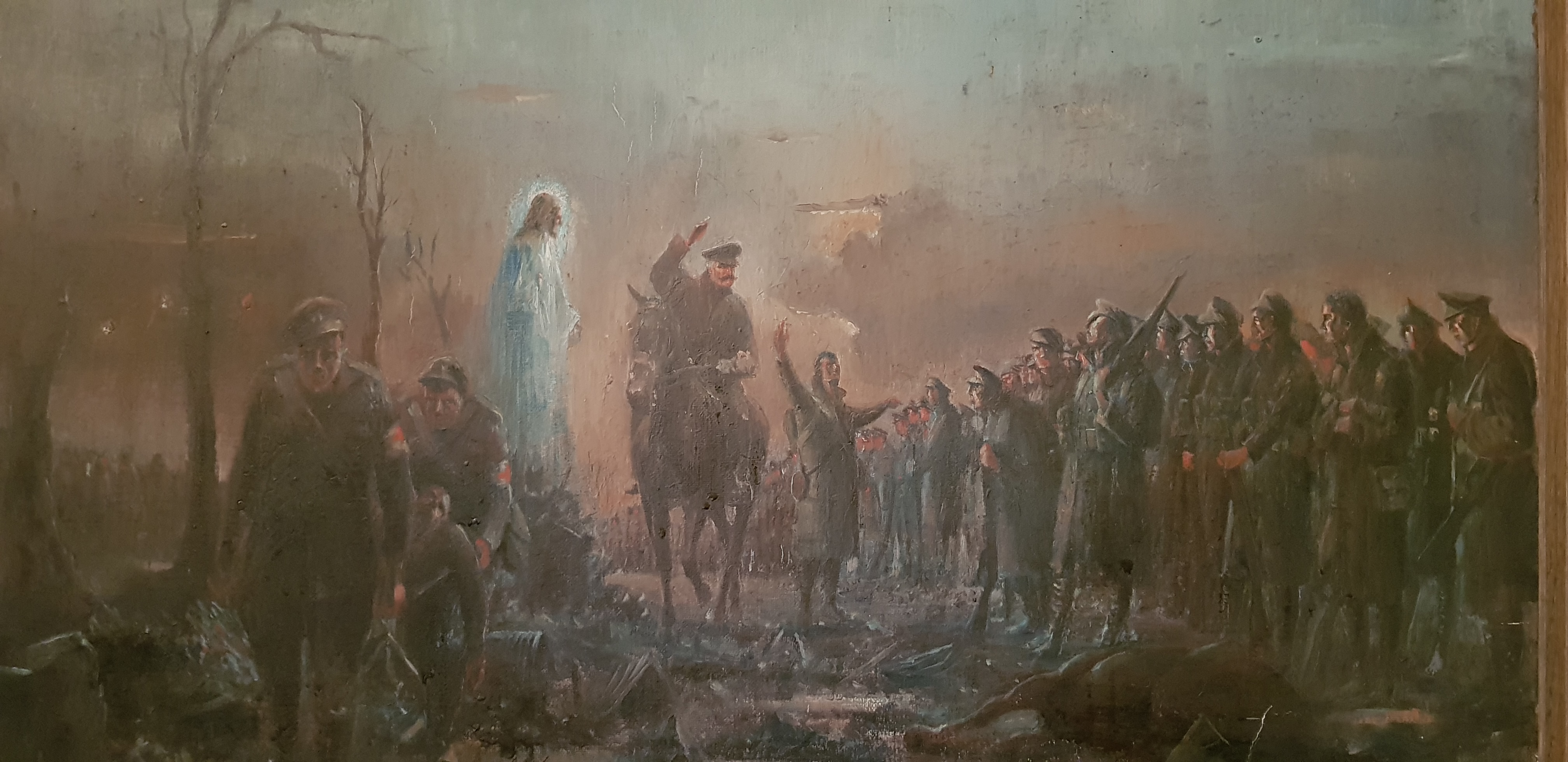
As they sang, awaiting their undeniable fate, the wind suddenly began to blow the mustard gas in the other direction. Not a single one of those soldiers died that day. When the war was over Captain Wade (then Private Wade) recalled the miracle of that day and made a painting of the men who rose up singing “Abide with Me.” The painting entitled, “The Miracle of Ypres” features a silhouette of the Lord watching over the soldiers in that darkest hour; rescued by Him to fight again another day.
Often when it seems that all hope is lost, God will miraculously intervene for those who abide in Him. We are told in Psalm 11 that He “tests the righteous”. Though it may seem to you that His eyes are closed, be assured that He neither slumbers nor sleeps, and that abiding in Him is the securest place on Earth; so that whether He intervenes miraculously or not, you will be safe in Him, who will never leave nor forsake you.
Copyright 1999-2026 Worthy Devotions. This devotional was originally published on Worthy Devotions and was reproduced with permission.
How to display the above article within the Worthy Suite WordPress Plugin.
[worthy_plugins_devotion_single_body]The children of Israel are facing yet another test, this one, even more severe than hunger– dehydration – which, unabated, quickly leads to a miserable death. Yet, now, every day they are also seeing the miracles of God, who is feeding them regularly with manna, and surrounding them by a pillar of cloud by day and a pillar of fire by night. Once again, they fail the test, even in the midst of their daily witness of miracles. So even though the test is more severe, the evidence for trust is that much greater.
Is there something about miracles that makes them forgettable? Or is the problem with us? After journeying for a season the children of Israel were faced with hunger — another test. This time, naturally faced with starvation, they murmured against the Lord, AGAIN! You’d think they might begin to put it together that God truly wanted them to trust Him. Apparently not yet. The dire circumstances attacked their mass cerebral cortex (memory) and once again they went into attack mode, bitterly complaining in unbelief. The Ten Plagues, the pillar of fire, the Red Sea walk, the Egyptian chariot soup, none of these connected to the present hunger pangs. Nature trumped super-nature, and sadly, God Himself.
The Apostle Paul’s discourse in 1 Corinthians 10 recalls the great miracles God performed for the children of Israel during the time of the Exodus. Delivered from Egypt and Pharaoh’s slavery, they were dismayed to discover his maniacal rage pursuing them anew, driving them into a deadly corner and imminent destruction. Humanly speaking, their terror and panic was understandable. With their eyes they could only see the wrath of Egypt succeeding at last to utterly destroy them. In that state of mind, how might they have remembered the consecutive miracles God had wrought against Egypt which had brought them to this very place?
When Ruth pledged her alligence to Naomi and to the God of Israel, it wasn’t based on, “What ifs?” or circumstances. It was a faith rooted in her devotion to Naomi and God even to the point of death!
This season of the Resurrection also occurs during a significant Old Testament feast day, the feast of “Firstfruits” (Hebrew, “bikoreem”). When Yeshua (Jesus) rose from the dead he was the firstfruit of the resurrection. On that day the keys of Hell and Death were obtained by our Lord. The apostle Paul connected the resurrection with the feast of Firstfruits in his letter to the congregation at Corinith. “But now Christ is risen from the dead, and has become the firstfruits of those who have fallen asleep.”
There is a long standing tradition of cleaning one’s house in the springtime – hence the term “spring cleaning”. One source for this tradition is certainly the Jewish Passover (Pesach). Each spring as the holiday approaches observant householders in Israel and around the world perform a meticulous cleaning of their homes, especially to be sure there is no leaven in the house before Pesach begins. Leaven, in scripture, is often a metaphor for sin and impurity; and this season of the year is often a time for emphasizing “spiritual housecleaning”.
I’ve heard so many Christians ask, “How can I get more of the Holy Spirit?” As if the Holy Spirit is some kind of power or force that we can control or weild. What we should really be asking is, “How can the Holy Spirit have more of me?”