John 15:5 I am the vine; you are the branches. Whoever abides in me and I in him, he it is that bears much fruit, for apart from me you can do nothing.
Living in Israel all these years, I often encounter amazing stories of God’s deliverance and grow increasingly fond of listening to the fascinating ways He shows His power. During our tour in England a few years ago, we met a man whose family experienced a great miracle during WW1. He tells this incredible story…
That era evinced a dramatic and historic change in the tactics of warfare. Battle lines were formed by trenches and widespread use of chemical weapons often determined the outcome, since chemical warfare had not yet been banned by the Geneva convention.
During one such battle, the British faced a German attack with mustard gas. The British regiment, insufficiently equipped with gas masks, was addressed by commander Lt. Colonel Ernest Vaux (our friend’s great-great grandfather). He stood up and said to his battalion, “Friends, there is no use running… come up here and let us sing a hymn”. In that dark and desperate moment, with poison filling the air and all hope evaporating, the soldiers rose out from the trenches and began to sing the powerful lyrics of “Abide with Me” in one accord.
“Abide with me, fast falls the eventide
The darkness deepens Lord, with me abide
When other helpers fail and comforts flee
Help of the helpless, oh, abide with me
Swift to its close ebbs out life’s little day
Earth’s joys grow dim, its glories pass away
Change and decay in all around I see
O Thou who changest not, abide with me
I fear no foe, with Thee at hand to bless
Ills have no weight, and tears no bitterness
Where is death’s sting?
Where, grave, thy victory?
I triumph still, if Thou abide with me
Hold Thou Thy cross before my closing eyes
Shine through the gloom and point me to the skies
Heaven’s morning breaks, and earth’s vain shadows flee
In life, in death, O Lord, abide with me
Abide with me, abide with me
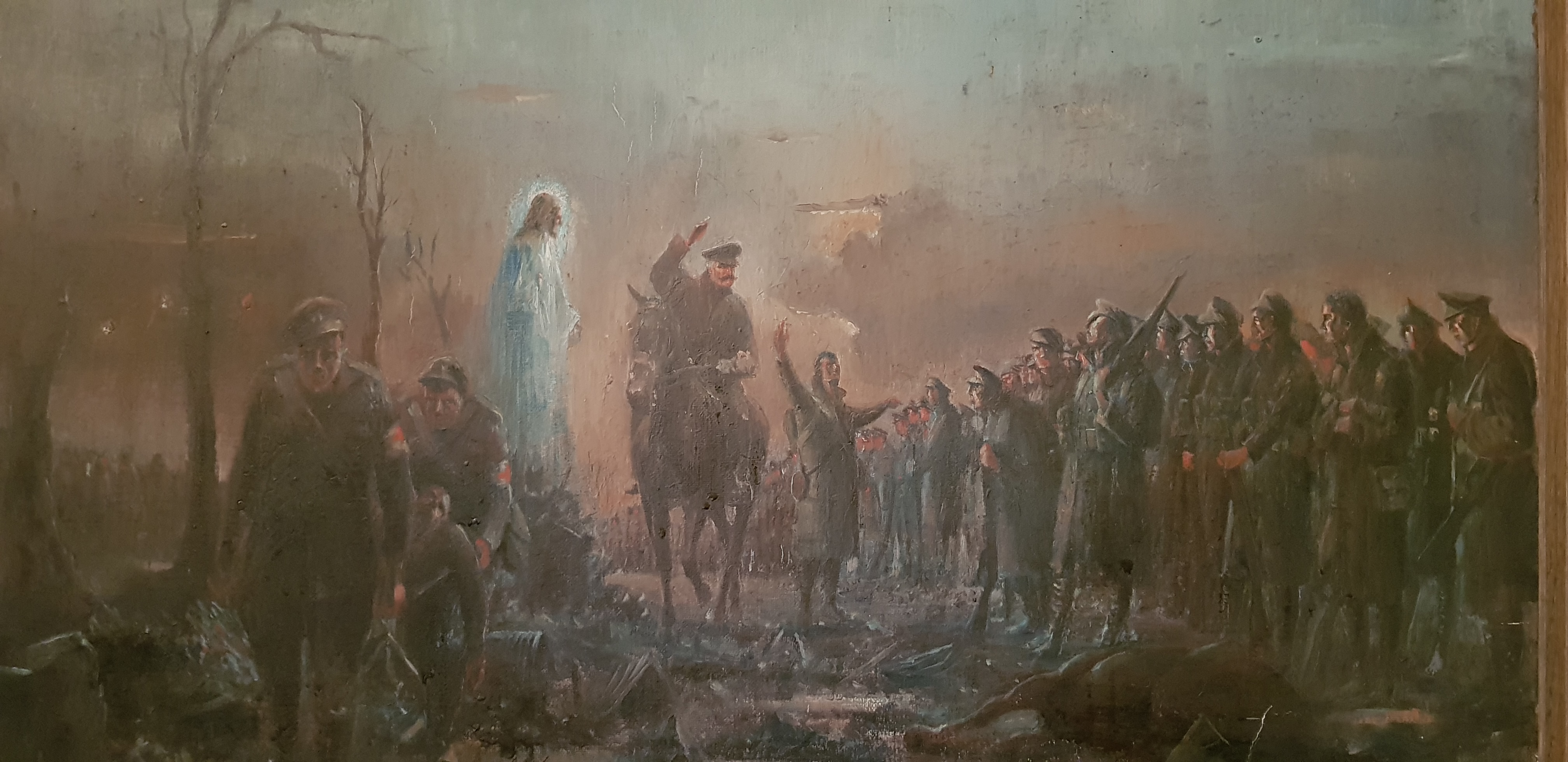
As they sang, awaiting their undeniable fate, the wind suddenly began to blow the mustard gas in the other direction. Not a single one of those soldiers died that day. When the war was over Captain Wade (then Private Wade) recalled the miracle of that day and made a painting of the men who rose up singing “Abide with Me.” The painting entitled, “The Miracle of Ypres” features a silhouette of the Lord watching over the soldiers in that darkest hour; rescued by Him to fight again another day.
Often when it seems that all hope is lost, God will miraculously intervene for those who abide in Him. We are told in Psalm 11 that He “tests the righteous”. Though it may seem to you that His eyes are closed, be assured that He neither slumbers nor sleeps, and that abiding in Him is the securest place on Earth; so that whether He intervenes miraculously or not, you will be safe in Him, who will never leave nor forsake you.
Copyright 1999-2026 Worthy Devotions. This devotional was originally published on Worthy Devotions and was reproduced with permission.
How to display the above article within the Worthy Suite WordPress Plugin.
[worthy_plugins_devotion_single_body]As we discussed last week, the word for “sign” in ancient Hebrew is “oht”. It was used in Genesis to designate God’s covenant sign with Noah, (the rainbow). And we see now the same word again, in Exodus, identified with the deliverance of the Jewish people from the tenth plague, when the angel of death passed through all Egypt to strike the firstborn. Anyone under the “sign” of the blood was spared.
Yesterday we wrote about one of the greatest moves of God … the Moravian Revival. When the community was in complete disarray, Count Zinzendorf focused on how they could live together in love despite their differences. He called all the men together for an intense study of the Scriptures to focus on how Christian life in community was portrayed. These studies combined with intense prayer convinced many of the believers that they were called to live together in love and that their disunity and conflict were contrary to the clear calling of Scripture.
In the late 1800s, an awakening in South Africa led by Andrew Murray was a powerful move of God. Studying that revival yields essential insights concerning the events occurring now throughout the United States. As the spirit of God began to move in Cape Town, Murray compared the SA revival with past experiences of revivals in Europe. He decided that the intense “emotionalism” was a false experience of God and charged in to break up the meeting. Stepping out of the church, he encountered his father standing and weeping. His father rebuked Andrew, “How dare you stop something that I have prayed to happen for 30 years!”
Revivals, that is, genuine Divinely ordained seasons of the activity of God among men, have a universally unusual character. Normal activities and behaviors give way to the tangible influence of God’s Holy Spirit, whose inspiration brings a freedom of expression, emotion, conviction, worship, and other variations from normal experience.
During the Catholic inquisitions, as millions of Christians were being killed by the Jesuit Priests for apostasy, throughout Europe, Christians were fleeing. In Bohemia alone, there were an estimated 4,000,000 Christians before the Jesuit inquisition, and ten years later, only 800,000 people remained in Bohemia – all of whom were Catholic. These terrible events prepared the ground for one of the greatest moves of God that have ever been recorded, the Moravian Revival, which lasted for over 100 years. Gustav Warneck, the German Historian of Protestant Missions, testified, “This small church in twenty years called into being more missions than the whole Evangelical Church has done in two centuries.”
I love to study past revivals and in studying them, there are two recurring themes that stand out:
First, that He has often used obscure and unknown individuals to lead revivals, and that even these men whom He used so powerfully never considered themselves to be “special”, but often wanted to stay out of the limelight.
During the Great Depression, poverty swept across America like a whirling tornado, ripping up dreams and scattering hopes to the wind. One such poverty twister hit a small part of Texas where a man named Yates ran a sheep ranch. Struggling even to keep food on the table, Yates and his wife did all they could to survive. Finally, they had to accept a government subsidy or lose their home and land to the creditors.