by Stefan J. Bos, Worthy News Chief International Correspondent
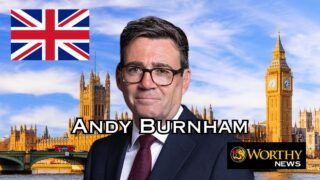
JERUSALEM/LONDON (Worthy News) – Andy Burnham became Britain’s new prime minister on Monday, replacing Keir Starmer after a Labour Party revolt and vowing a tougher approach toward Israel as part of an agenda that also includes sweeping economic reforms and devolving power from Westminster.
Burnham, the former mayor of Greater Manchester and the new Labour Party leader, succeeded Starmer as Britain’s seventh prime minister in a decade after pledging to tackle the country’s cost-of-living crisis, overhaul public services and take a firmer line on Israel’s conduct in the war in Gaza.
As part of his domestic agenda, Burnham also pledged to end homelessness, making the issue one of his first priorities as prime minister. “I will soon go through that door behind me and issue my first instruction: to end rough sleeping in our country,” he told reporters gathered outside his official residence at 10 Downing Street.
He also promised a 10-year plan to “rewire Britain,” saying he wanted to restore political stability, spread power beyond Westminster and rebuild confidence in government after years of political turmoil.
“Burnham enters Downing Street with considerable domestic political experience but a comparatively limited record in foreign affairs. His clearest Middle East positions concern Israel, the Palestinians, and Gaza,” commented The Jerusalem Post newspaper.
TOUGHER ISRAEL STANCE
“On Iran, the Gulf states, and most of the wider region, he has said much less.”
Burnham recently apologized for Labour’s initial response to Israel’s military campaign in Gaza, saying the party “didn’t get it right” and needed to “do better” under his leadership, signaling a significant shift in the U.K.’s approach toward Israel and the Gaza conflict.
The prime minister told media this month he would put more pressure on the Israeli government, including through additional sanctions on individuals and entities, while also considering a ban on trade involving goods from Israeli settlements in the occupied West Bank.
“I know many people feel that at the start of Israel’s military action in Gaza my party didn’t get it right and I am sorry about that,” Burnham said.
CALL FOR PRESSURE
“The response has too often not been good enough. We need to do better.”
He later added: “We’ve got to do more to put pressure on the Israeli government. Yes, we have taken some important steps. But let’s be honest, the U.K. was too slow to call for a ceasefire. We must now do more to strengthen our approach.”
However, Burnham stopped short of describing Israel’s actions in Gaza as genocide — a key demand from parts of Labour’s political left — saying that determination should be left to international courts.
“I have been absolutely appalled by what I’ve seen and read about the destruction of Gaza. There’s increasing evidence that war crimes appear to have been committed,” he said.
INTERNATIONAL COURTS
“There must be accountability for the depth of the suffering the people of Gaza have experienced. Ultimately, however, it must be for the international courts to determine, rather than politicians.”
Burnham, 56, returned to Parliament in June after winning a specially arranged by-election and was sworn in as an MP on July 12, shortly after Starmer announced he would step down following mounting pressure from Labour lawmakers and cabinet ministers.
Facing mounting pressure from Labour lawmakers, disappointing local election results, falling opinion poll ratings and growing concern over the rise of Nigel Farage’s Reform UK, Starmer announced he would step down, saying the Labour Party needed new leadership after just two years in office.
The new prime minister is expected to focus first on easing the cost-of-living crisis, boosting economic growth, devolving more powers from Westminster, reducing homelessness, reforming public services and reshaping the U.K.’s foreign policy, including toward Israel.
CONSTITUTIONAL TRANSFER
He immediately began forming a new cabinet, with several senior Starmer allies leaving government as Burnham assembled his administration.
Before Burnham could take office, Starmer traveled the roughly one mile (1.6 kilometers) from 10 Downing Street to Buckingham Palace to formally tender his resignation to King Charles III.
Under Britain’s constitutional monarchy, a prime minister cannot simply resign publicly; the resignation must first be accepted by the monarch, who then invites the person most likely to command a majority in the House of Commons to form a new government.
King Charles accepted Starmer’s resignation before inviting Burnham to form a government during a private audience at Buckingham Palace. Burnham accepted the invitation and returned to Downing Street as Britain’s new prime minister, completing the constitutional transfer of power that formally ended the Starmer era.
Copyright 1999-2026 Worthy News. This article was originally published on Worthy News and was reproduced with permission.
The following code is how the above article is generated with the Worthy Suite WordPress Plugin.
[worthy_plugins_news_story_body]This is how you display a story with an image.
Britain Gets New PM As Burnham Vows Tougher Israel Stance
by Stefan J. Bos, Worthy News Chief International Correspondent
JERUSALEM/LONDON (Worthy News) – Andy Burnham became Britain’s new prime minister on Monday, replacing Keir Starmer after a Labour Party revolt and vowing a tougher approach toward Israel as part of an agenda that also includes sweeping economic reforms and devolving power from Westminster.
Burnham, the former mayor of Greater Manchester and the new Labour Party leader, succeeded Starmer as Britain’s seventh prime minister in a decade after pledging to tackle the country’s cost-of-living crisis, overhaul public services and take a firmer line on Israel’s conduct in the war in Gaza.
As part of his domestic agenda, Burnham also pledged to end homelessness, making the issue one of his first priorities as prime minister. “I will soon go through that door behind me and issue my first instruction: to end rough sleeping in our country,” he told reporters gathered outside his official residence at 10 Downing Street.
He also promised a 10-year plan to “rewire Britain,” saying he wanted to restore political stability, spread power beyond Westminster and rebuild confidence in government after years of political turmoil.
“Burnham enters Downing Street with considerable domestic political experience but a comparatively limited record in foreign affairs. His clearest Middle East positions concern Israel, the Palestinians, and Gaza,” commented The Jerusalem Post newspaper.
TOUGHER ISRAEL STANCE
“On Iran, the Gulf states, and most of the wider region, he has said much less.”
Burnham recently apologized for Labour’s initial response to Israel’s military campaign in Gaza, saying the party “didn’t get it right” and needed to “do better” under his leadership, signaling a significant shift in the U.K.’s approach toward Israel and the Gaza conflict.
The prime minister told media this month he would put more pressure on the Israeli government, including through additional sanctions on individuals and entities, while also considering a ban on trade involving goods from Israeli settlements in the occupied West Bank.
“I know many people feel that at the start of Israel’s military action in Gaza my party didn’t get it right and I am sorry about that,” Burnham said.
CALL FOR PRESSURE
“The response has too often not been good enough. We need to do better.”
He later added: “We’ve got to do more to put pressure on the Israeli government. Yes, we have taken some important steps. But let’s be honest, the U.K. was too slow to call for a ceasefire. We must now do more to strengthen our approach.”
However, Burnham stopped short of describing Israel’s actions in Gaza as genocide — a key demand from parts of Labour’s political left — saying that determination should be left to international courts.
“I have been absolutely appalled by what I’ve seen and read about the destruction of Gaza. There’s increasing evidence that war crimes appear to have been committed,” he said.
INTERNATIONAL COURTS
“There must be accountability for the depth of the suffering the people of Gaza have experienced. Ultimately, however, it must be for the international courts to determine, rather than politicians.”
Burnham, 56, returned to Parliament in June after winning a specially arranged by-election and was sworn in as an MP on July 12, shortly after Starmer announced he would step down following mounting pressure from Labour lawmakers and cabinet ministers.
Facing mounting pressure from Labour lawmakers, disappointing local election results, falling opinion poll ratings and growing concern over the rise of Nigel Farage’s Reform UK, Starmer announced he would step down, saying the Labour Party needed new leadership after just two years in office.
The new prime minister is expected to focus first on easing the cost-of-living crisis, boosting economic growth, devolving more powers from Westminster, reducing homelessness, reforming public services and reshaping the U.K.’s foreign policy, including toward Israel.
CONSTITUTIONAL TRANSFER
He immediately began forming a new cabinet, with several senior Starmer allies leaving government as Burnham assembled his administration.
Before Burnham could take office, Starmer traveled the roughly one mile (1.6 kilometers) from 10 Downing Street to Buckingham Palace to formally tender his resignation to King Charles III.
Under Britain’s constitutional monarchy, a prime minister cannot simply resign publicly; the resignation must first be accepted by the monarch, who then invites the person most likely to command a majority in the House of Commons to form a new government.
King Charles accepted Starmer’s resignation before inviting Burnham to form a government during a private audience at Buckingham Palace. Burnham accepted the invitation and returned to Downing Street as Britain’s new prime minister, completing the constitutional transfer of power that formally ended the Starmer era.
Copyright 1999-2026 Worthy News. This article was originally published on Worthy News and was reproduced with permission.
[worthy_plugins_news_story_title]
<div style="text-align:right; padding:0px 0px 10px 15px; float:right; width:300px;"><img src="[worthy_plugins_news_story_image name=sm_medium]" alt="" /></div>[worthy_plugins_news_story_body]