by Emmitt Barry, Worthy News Washington D.C. Bureau Chief
(Worthy News) – President Donald Trump has granted a key federal approval for a major new oil pipeline from Canada into the United States, a project already being dubbed “Keystone Light” for its resemblance to the previously canceled Keystone XL.
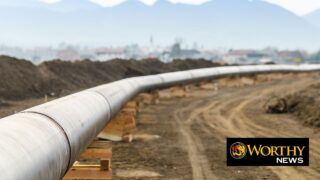
The Bridger Pipeline Expansion, a roughly 650-mile project, is designed to carry up to 550,000 barrels of oil per day from Canada through Montana into Wyoming, with the potential to scale significantly higher. Industry analysts say the pipeline could ultimately move more than 1 million barrels per day under optimized conditions, positioning it as a major artery for North American energy supply.
The approval marks a sharp policy shift from the decision by Joe Biden, who revoked Keystone XL’s permit in 2021 over climate concerns. Under the new authorization, development work is expected to move forward quickly, with construction targeted to begin in 2027 and completion projected by 2028 or early 2029.
Energy leaders say the pipeline strengthens U.S. energy security while deepening ties with Canada, America’s largest foreign oil supplier. The design also includes potential connections to the Bakken shale region, opening additional domestic production pathways and expanding export flexibility.
However, the project is already drawing opposition from environmental groups and activists who warn of spill risks and long-term ecological damage. Critics point to a past spill involving the pipeline operator and argue the expansion could threaten water supplies, farmland, and wildlife habitats across Montana and surrounding areas.
Supporters counter that the route avoids many of the most controversial areas that plagued Keystone XL and follows existing infrastructure corridors for much of its path, reducing environmental disruption. They also argue that modern pipeline technology significantly lowers the risk of major incidents.
Beyond the immediate project, the approval comes as Canada looks to diversify its energy exports. While more than 90% of Canadian crude currently flows into the U.S., officials are exploring new pipeline routes to the West Coast to access Asian and Middle Eastern markets, signaling a broader shift in global energy strategy.
For now, the “Keystone Light” project stands as a defining moment in the renewed push for North American energy independence—one that could reshape supply lines, economic growth, and geopolitical alignment in the years ahead.
Copyright 1999-2026 Worthy News. This article was originally published on Worthy News and was reproduced with permission.
The following code is how the above article is generated with the Worthy Suite WordPress Plugin.
[worthy_plugins_news_story_body]This is how you display a story with an image.
Trump Approves “Keystone Light” Pipeline, Reviving North American Energy Push
by Emmitt Barry, Worthy News Washington D.C. Bureau Chief
(Worthy News) – President Donald Trump has granted a key federal approval for a major new oil pipeline from Canada into the United States, a project already being dubbed “Keystone Light” for its resemblance to the previously canceled Keystone XL.
The Bridger Pipeline Expansion, a roughly 650-mile project, is designed to carry up to 550,000 barrels of oil per day from Canada through Montana into Wyoming, with the potential to scale significantly higher. Industry analysts say the pipeline could ultimately move more than 1 million barrels per day under optimized conditions, positioning it as a major artery for North American energy supply.
The approval marks a sharp policy shift from the decision by Joe Biden, who revoked Keystone XL’s permit in 2021 over climate concerns. Under the new authorization, development work is expected to move forward quickly, with construction targeted to begin in 2027 and completion projected by 2028 or early 2029.
Energy leaders say the pipeline strengthens U.S. energy security while deepening ties with Canada, America’s largest foreign oil supplier. The design also includes potential connections to the Bakken shale region, opening additional domestic production pathways and expanding export flexibility.
However, the project is already drawing opposition from environmental groups and activists who warn of spill risks and long-term ecological damage. Critics point to a past spill involving the pipeline operator and argue the expansion could threaten water supplies, farmland, and wildlife habitats across Montana and surrounding areas.
Supporters counter that the route avoids many of the most controversial areas that plagued Keystone XL and follows existing infrastructure corridors for much of its path, reducing environmental disruption. They also argue that modern pipeline technology significantly lowers the risk of major incidents.
Beyond the immediate project, the approval comes as Canada looks to diversify its energy exports. While more than 90% of Canadian crude currently flows into the U.S., officials are exploring new pipeline routes to the West Coast to access Asian and Middle Eastern markets, signaling a broader shift in global energy strategy.
For now, the “Keystone Light” project stands as a defining moment in the renewed push for North American energy independence—one that could reshape supply lines, economic growth, and geopolitical alignment in the years ahead.
Copyright 1999-2026 Worthy News. This article was originally published on Worthy News and was reproduced with permission.
[worthy_plugins_news_story_title]
<div style="text-align:right; padding:0px 0px 10px 15px; float:right; width:300px;"><img src="[worthy_plugins_news_story_image name=sm_medium]" alt="" /></div>[worthy_plugins_news_story_body]