by Emmitt Barry, Worthy News Washington D.C. Bureau Chief
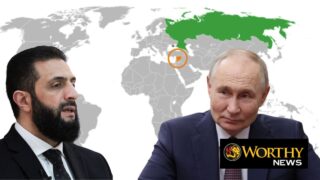
DAMASCUS, SYRIA (Worthy News) – Syria and Russia have reached an agreement that will strip Moscow of exclusive control over two strategic military bases on Syria’s Mediterranean coast, marking a major shift in Russia’s Middle East military presence following the collapse of the Bashar al-Assad government.
Under a memorandum of understanding announced by Syria’s Foreign Ministry, Damascus will assume control of Hmeimim Air Base and civilian and commercial facilities at Tartus, while military installations at the two sites are to be converted into joint Syrian-Russian training and qualification centers. The transition is expected to take place within three months.
The agreement follows roughly 18 months of negotiations between Moscow and Syria’s new leadership after Assad was overthrown in December 2024. Russia had been Assad’s principal foreign military backer and used its intervention in Syria to establish a powerful strategic presence in the eastern Mediterranean.
Russia Loses a Strategic Mediterranean Foothold
For years, Tartus served as Russia’s principal naval support facility in the Mediterranean, while Hmeimim provided Moscow with an air operations hub from which Russian forces could operate throughout Syria and project military power deeper into the Middle East and Africa.
Syria will now take control of the commercial berth at Tartus, including Pier No. 4 and associated warehouses and facilities. Russia had previously sought to develop the site as a commercial logistics hub, but any future operations will remain under Syrian jurisdiction.
The Syrian Foreign Ministry described the deal as a reorganization of Russia’s presence along the coast and said it represented the most significant development in bilateral negotiations since talks began.
Russia is therefore not disappearing entirely from Syria. However, converting military facilities into joint training centers dramatically changes a relationship in which Moscow once operated the bases as powerful extensions of its own armed forces.
Syria Rebalances Its Foreign Relations
The agreement comes as Syria’s post-Assad government broadens relations with the United States, Europe and Arab governments while reducing its dependence on Moscow.
President Ahmad al-Sharaa has nevertheless maintained diplomatic ties with Russian President Vladimir Putin, visiting Moscow twice since taking power. The future of Tartus and Hmeimim has been among the central issues between the two governments.
The strategic consequences extend well beyond Syria.
Russia’s bases allowed Moscow to maintain a permanent military presence on NATO’s southern flank, support operations throughout the Mediterranean and provide logistical connections to Russian activities in Africa.
What was once one of Moscow’s most secure military positions outside the former Soviet Union has now become dependent upon cooperation with a Syrian government seeking relationships in several competing directions.
Copyright 1999-2026 Worthy News. This article was originally published on Worthy News and was reproduced with permission.
The following code is how the above article is generated with the Worthy Suite WordPress Plugin.
[worthy_plugins_news_story_body]This is how you display a story with an image.
Syria Moves to Reclaim Key Mediterranean Bases as Russia’s Military Foothold Shrinks
by Emmitt Barry, Worthy News Washington D.C. Bureau Chief
DAMASCUS, SYRIA (Worthy News) – Syria and Russia have reached an agreement that will strip Moscow of exclusive control over two strategic military bases on Syria’s Mediterranean coast, marking a major shift in Russia’s Middle East military presence following the collapse of the Bashar al-Assad government.
Under a memorandum of understanding announced by Syria’s Foreign Ministry, Damascus will assume control of Hmeimim Air Base and civilian and commercial facilities at Tartus, while military installations at the two sites are to be converted into joint Syrian-Russian training and qualification centers. The transition is expected to take place within three months.
The agreement follows roughly 18 months of negotiations between Moscow and Syria’s new leadership after Assad was overthrown in December 2024. Russia had been Assad’s principal foreign military backer and used its intervention in Syria to establish a powerful strategic presence in the eastern Mediterranean.
Russia Loses a Strategic Mediterranean Foothold
For years, Tartus served as Russia’s principal naval support facility in the Mediterranean, while Hmeimim provided Moscow with an air operations hub from which Russian forces could operate throughout Syria and project military power deeper into the Middle East and Africa.
Syria will now take control of the commercial berth at Tartus, including Pier No. 4 and associated warehouses and facilities. Russia had previously sought to develop the site as a commercial logistics hub, but any future operations will remain under Syrian jurisdiction.
The Syrian Foreign Ministry described the deal as a reorganization of Russia’s presence along the coast and said it represented the most significant development in bilateral negotiations since talks began.
Russia is therefore not disappearing entirely from Syria. However, converting military facilities into joint training centers dramatically changes a relationship in which Moscow once operated the bases as powerful extensions of its own armed forces.
Syria Rebalances Its Foreign Relations
The agreement comes as Syria’s post-Assad government broadens relations with the United States, Europe and Arab governments while reducing its dependence on Moscow.
President Ahmad al-Sharaa has nevertheless maintained diplomatic ties with Russian President Vladimir Putin, visiting Moscow twice since taking power. The future of Tartus and Hmeimim has been among the central issues between the two governments.
The strategic consequences extend well beyond Syria.
Russia’s bases allowed Moscow to maintain a permanent military presence on NATO’s southern flank, support operations throughout the Mediterranean and provide logistical connections to Russian activities in Africa.
What was once one of Moscow’s most secure military positions outside the former Soviet Union has now become dependent upon cooperation with a Syrian government seeking relationships in several competing directions.
Copyright 1999-2026 Worthy News. This article was originally published on Worthy News and was reproduced with permission.
[worthy_plugins_news_story_title]
<div style="text-align:right; padding:0px 0px 10px 15px; float:right; width:300px;"><img src="[worthy_plugins_news_story_image name=sm_medium]" alt="" /></div>[worthy_plugins_news_story_body]