John 15:5 I am the vine; you are the branches. Whoever abides in me and I in him, he it is that bears much fruit, for apart from me you can do nothing.
Living in Israel all these years, I often encounter amazing stories of God’s deliverance and grow increasingly fond of listening to the fascinating ways He shows His power. During our tour in England a few years ago, we met a man whose family experienced a great miracle during WW1. He tells this incredible story…
That era evinced a dramatic and historic change in the tactics of warfare. Battle lines were formed by trenches and widespread use of chemical weapons often determined the outcome, since chemical warfare had not yet been banned by the Geneva convention.
During one such battle, the British faced a German attack with mustard gas. The British regiment, insufficiently equipped with gas masks, was addressed by commander Lt. Colonel Ernest Vaux (our friend’s great-great grandfather). He stood up and said to his battalion, “Friends, there is no use running… come up here and let us sing a hymn”. In that dark and desperate moment, with poison filling the air and all hope evaporating, the soldiers rose out from the trenches and began to sing the powerful lyrics of “Abide with Me” in one accord.
“Abide with me, fast falls the eventide
The darkness deepens Lord, with me abide
When other helpers fail and comforts flee
Help of the helpless, oh, abide with me
Swift to its close ebbs out life’s little day
Earth’s joys grow dim, its glories pass away
Change and decay in all around I see
O Thou who changest not, abide with me
I fear no foe, with Thee at hand to bless
Ills have no weight, and tears no bitterness
Where is death’s sting?
Where, grave, thy victory?
I triumph still, if Thou abide with me
Hold Thou Thy cross before my closing eyes
Shine through the gloom and point me to the skies
Heaven’s morning breaks, and earth’s vain shadows flee
In life, in death, O Lord, abide with me
Abide with me, abide with me
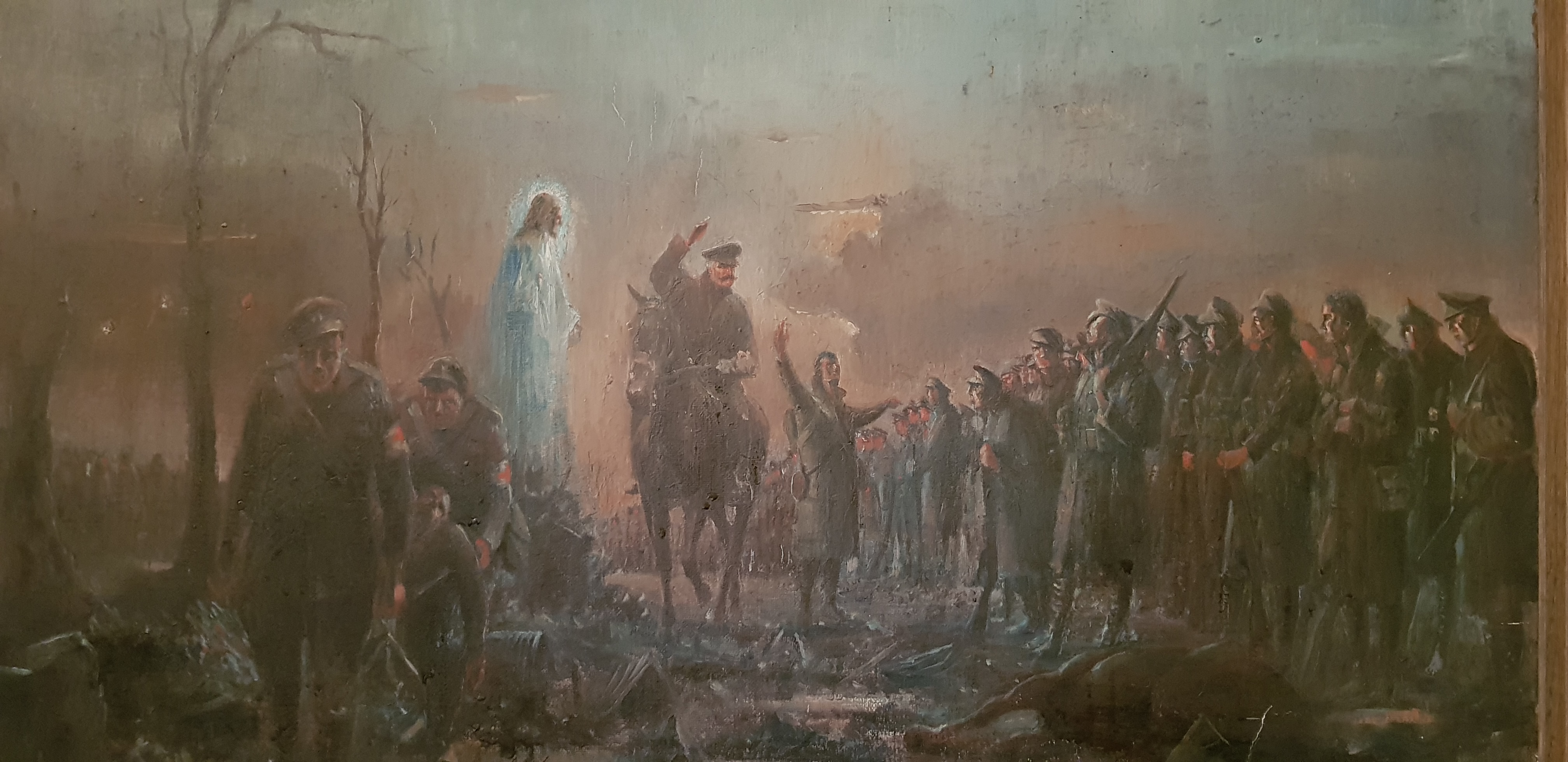
As they sang, awaiting their undeniable fate, the wind suddenly began to blow the mustard gas in the other direction. Not a single one of those soldiers died that day. When the war was over Captain Wade (then Private Wade) recalled the miracle of that day and made a painting of the men who rose up singing “Abide with Me.” The painting entitled, “The Miracle of Ypres” features a silhouette of the Lord watching over the soldiers in that darkest hour; rescued by Him to fight again another day.
Often when it seems that all hope is lost, God will miraculously intervene for those who abide in Him. We are told in Psalm 11 that He “tests the righteous”. Though it may seem to you that His eyes are closed, be assured that He neither slumbers nor sleeps, and that abiding in Him is the securest place on Earth; so that whether He intervenes miraculously or not, you will be safe in Him, who will never leave nor forsake you.
Copyright 1999-2026 Worthy Devotions. This devotional was originally published on Worthy Devotions and was reproduced with permission.
How to display the above article within the Worthy Suite WordPress Plugin.
[worthy_plugins_devotion_single_body]The captain of a submarine was once asked, "How did the terrible storm last night affect you?" The officer looked at him in surprise and exclaimed, "Storm? We didn't even know there was one!"
Soviet leader Nikita Khrushchev used to tell of a time when there was a wave of petty theft in the Soviet Union. To curtail this, the authorities put guards up around the factories.
This amazing passage defines all true believers in Messiah as "Abraham's seed and heirs according to God's promise". Abraham was known as the first Hebrew -- literally, "one who crosses over!" Before he crossed over into the promised land, we know from the scriptures that Abraham lived in a deeply idolatrous society and that even his own father was an idol worshiper. (Joshua 24:2) But one remarkable day, a call came to Abraham....a call from the Most High God -- and he became one who "crossed over" from idolatrous polytheism into a personal knowledge of the one true Creator God. So leaving his past behind, he entered a new life of spiritual truth and holiness and a new land of promise; a profound transformation, and for us, a beautiful picture of our own "crossing over" into the new life of Yeshua the Messiah.
Early in his life David was forced to flee from his king and father-in-law, Saul -- to flee for his life. During this long season of exile and hiding David began to find himself surrounded by loyal friends who joined themselves to him. But these were friends of an unusual kind: they were men who had all been unhappy, distressed, helpless, or in debt -- by and large, the outcasts of the world. But an amazing thing happened to these formerly hapless human beings when they joined with David; they were empowered and became his "mighty men." When David finally became King of Israel, these men were ennobled and raised to be princes and officers in his Kingdom.
Sukkot is a festival about rejoicing in the blessings that God has provided, but let’s be sure our focus is on the Lord of blessing – instead of the blessings!
During the Feast of Sukkot, the Jewish people took part in a water drawing ceremony on the last day of the feast. They would go down to the Pool of Siloam, draw water and bring it to the Temple Mount. Then they would pour out the water and recite Isaiah 12, "and with joy you shall draw water out of the wells (springs) of salvation." In Hebrew, the word salvation and Yeshua (Jesus, in Hebrew), are the same.
Though the new cycle of Israel's feasts has concluded, I'd like to share one more observation about last week's high holy day, Yom Kippur. It is a day on which adults are afflicting themselves by fasting, abstaining from all pleasures, and repenting. But for the children, Yom Kippur is a very different holiday. This day is my son Obi's favorite holiday! Why? Because the kids are not fasting or recalling their sins or suffering at all – they are celebrating freedom!